






Vercel and Cloudflare Workers both run modern web apps close to your visitors, and both have a free plan. Their bills are built very differently. Cloudflare charges for requests and CPU time, and nothing for bandwidth. Vercel charges a fee per deploying seat, then meters data transfer, CDN requests and function time against a monthly credit.
This comparison uses each vendor's own pricing pages, documentation and terms, checked on 21 November 2026. All prices are in US dollars, exclude VAT and are as of November 2026. circlemount.com runs on Cloudflare Workers, so we have a view, but Vercel is the better choice for some teams and we say where.
- Workers Paid is $5 a month per account, with 10 million requests and 30 million CPU milliseconds included. Static asset requests and bandwidth are free.
- Vercel Pro is $20 a month per deploying seat, with $20 of usage credit and 1 TB of data transfer included, then from $0.15 per GB.
- Vercel Hobby is free, but its terms limit it to personal or non-commercial use.
- In our illustrative month of 20 million requests and 2 TB of traffic, Workers comes to about $9.40 and Vercel Pro to between $120 and $191.
- Vercel is the stronger choice for Next.js features and preview workflows. Workers wins when bandwidth drives the bill.
How much does Vercel cost compared with Cloudflare Workers?
Cloudflare Workers Paid costs $5 a month per account. Vercel Pro costs $20 a month per deploying seat. Beyond that, each meters different things.
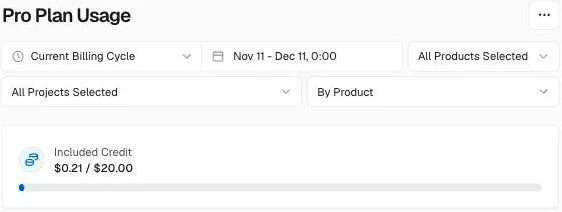
Vercel Pro's $20 platform fee includes $20 of usage credit, shown at the top of the team's usage page.
Cloudflare's Workers pricing has two plans. Free gives 100,000 requests a day and 10 milliseconds of CPU time per invocation. Paid has a $5 monthly minimum per account and includes 10 million requests and 30 million CPU milliseconds a month. After that it costs $0.30 per extra million requests and $0.02 per extra million CPU milliseconds. Cloudflare states that "Requests to static assets are free and unlimited", and that Workers carry no extra charge for data transfer or bandwidth. Containers are the exception, with their own egress rates.
Vercel's pricing page lists Hobby at $0, Pro at $20 a month and Enterprise at custom prices. The Pro plan documentation explains the $20: it is a platform fee that includes one deploying seat and $20 of monthly usage credit. Extra deploying seats cost $20 a month each, and viewer seats are free. Unused credit expires at the end of the month, and usage beyond it is billed on demand.
- 10M requests on Workers Paid, then $0.30 per extra million
- $0 for Workers static asset requests and data transfer
- 1 TB of Fast Data Transfer on Vercel Pro, then from $0.15 per GB
- $20 of usage credit with each Vercel Pro platform fee, expiring at month end
- 100 GB of Fast Data Transfer on the free Vercel Hobby plan
Sources: Cloudflare, Workers pricing; Vercel, Pricing; Vercel, Pro plan, all checked 21 November 2026
What exactly does each platform charge for?
Workers has two meters on the Paid plan: requests and CPU milliseconds. Requests for static files do not count, and neither does bandwidth. Vercel meters more resources, and each has its own allowance and rate:
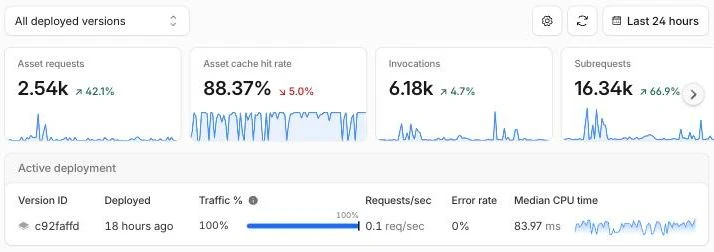
On Workers you pay for invocations and CPU time; the static asset requests counted here are free.
- Fast Data Transfer: data sent between Vercel's CDN and the visitor. 100 GB on Hobby and 1 TB on Pro, then from $0.15 per GB.
- CDN requests: every request the CDN handles, including static assets. From $2 per million on Pro.
- Fast Origin Transfer: data sent between the CDN and Vercel Functions.
- Function invocations: $0.60 per million on Pro.
- Active CPU: from $0.128 an hour, charged only while your code runs, not while it waits on a database or API.
- Provisioned memory: from $0.0106 per GB-hour, charged for as long as an instance is handling requests, including waits.
- Image optimisation and ISR: 5,000 image transformations a month on Hobby, then from $0.05 per 1,000 on Pro, with ISR reads and writes billed per million.
Vercel's fluid compute pricing and CDN usage pages define these meters. In practice, a static image on Vercel costs a CDN request plus its bytes. On Workers it costs nothing.
What Vercel charges in London
Vercel prices many resources by region, and regional rates apply to Pro. Its London (lhr1) pricing page lists Fast Data Transfer at $0.15 per GB, CDN requests at $2.40 per million, Fast Origin Transfer at $0.06 per GB, Active CPU at $0.177 an hour and provisioned memory at $0.0146 per GB-hour. The cheapest US regions charge $0.128 and $0.0106. Budget with London rates for UK visitors.
How many requests does Vercel Pro include?
Vercel's own pages disagree. The pricing page says Pro has "10M / month included" CDN requests, then from $2 per million. The Pro plan documentation and the Flat Rate CDN page say Pro includes the lowest Flat Rate CDN tier, with 1 million CDN requests and 1 TB of data transfer a month. We could not reconcile the two on 21 November 2026. Budget with the lower figure, then check the Usage page and your first invoice.
Is Vercel Hobby allowed for commercial use?
No. Section 4 of Vercel's Terms of Service says you may use Hobby only "for your personal or non-commercial use". The terms do not define commercial use. In our reading, a company website, a client project or an app that takes payments belongs on Pro. If you are unsure, ask Vercel before launch, not after.
Hobby is also capped. The Hobby plan documentation lists 100 GB of Fast Data Transfer, 10 GB of Fast Origin Transfer, 1 million CDN requests, 1 million function invocations, 4 CPU-hours and 360 GB-hours of memory a month. You cannot buy more. In most cases, a team that goes over must wait 30 days. A paused production deployment shows visitors a 503 DEPLOYMENT_PAUSED error, and a paused Hobby team stays paused until you act.
Workers Free has a different catch: 10 milliseconds of CPU time per invocation, which a server-rendered page doing real work can exceed. For a business, the $5 Paid plan is worth it for the higher CPU limit alone.
How do Cloudflare Workers and Vercel limits compare?
The limits measure different things, so compare them by what your app does. Cloudflare's Workers limits page caps CPU time and memory. Vercel caps how long a function runs in total. Build figures come from the Workers Builds documentation.
| Limit | Cloudflare Workers | Vercel |
|---|---|---|
| Free plan traffic | 100,000 requests a day | Hobby: 1 million CDN requests and 100 GB of Fast Data Transfer a month |
| Compute per request | CPU time: 10 ms on Free; 30 seconds by default on Paid, up to 5 minutes | Wall-clock duration: 300 seconds on Hobby; 300 seconds by default on Pro, configurable up to 800 seconds |
| Waiting on other services | No wall-clock limit on HTTP requests while the client stays connected | Counts towards duration and provisioned memory, not Active CPU |
| Memory | 128 MB per isolate on both plans | Set per function and billed per GB-hour |
| Builds and deploys | Workers Builds: 3,000 build minutes a month on Free, 6,000 on Paid, then $0.005 a minute | 100 deployments a day on Hobby, 6,000 on Pro |
What would the same app cost on Workers and on Vercel?
These are illustrative examples from the published rates, not quotes. We assume every request runs server code at an average of 5 ms of CPU, one deploying seat, and US base rates unless London is stated. Database costs are excluded, because a Supabase project costs the same whichever host calls it.
| Example month | How the bill is worked out | Monthly total |
|---|---|---|
| (a) 2M requests, 200 GB out: Workers Paid | 2M requests and 10M CPU-ms are inside the included 10M and 30M; bandwidth is free | $5 |
| (a) Vercel Pro | Transfer is inside 1 TB. Invocations 2M x $0.60 = $1.20, plus CPU 2.8 hours x $0.128 to $0.177 = $0.36 to $0.49. Usage of $1.56 to $1.69 sits inside the $20 credit | $20 |
| (b) 20M requests, 2 TB out: Workers Paid | $5 base, plus (20M - 10M) x $0.30 = $3.00 for requests, plus (100M - 30M CPU-ms) x $0.02 = $1.40 | $9.40 |
| (b) Vercel Pro, on demand | 1,000 GB over the 1 TB x $0.15 = $150, plus 10M requests x $2 to $2.40 = $20 to $24, plus invocations $12, plus CPU $3.56 to $4.92 | About $186 to $191 |
| (b) Vercel Pro, $100 Flat Rate CDN tier | $20 platform fee plus the $100 tier (50M requests, 50 TB); invocations and CPU of about $16 to $17 sit inside the credit | About $120 |
USD before VAT. Assumes 5 ms average CPU per request and one seat; excludes Vercel provisioned memory and database costs.
| Example and plan | Per month |
|---|---|
| (a) Workers Paid | |
| (a) Vercel Pro | |
| (b) Workers Paid | |
| (b) Vercel Pro, $100 Flat Rate tier | |
| (b) Vercel Pro, on demand |
Sources: Cloudflare, Workers pricing; Vercel, Pricing; Vercel, Flat Rate CDN; Vercel, London (lhr1) pricing, all checked 21 November 2026
Read the numbers with these caveats:
- The included-requests conflict. If Pro includes only 1 million CDN requests, example (a) would outgrow the included Flat Rate tier, and Vercel moves you up a tier the next cycle: $20 plus the $20 tier, or $40. On demand, example (b) would rise to about $204 to $213.
- Fast Origin Transfer. If responses come from functions rather than the cache, London's $0.06 per GB could add up to $12 in example (a), still inside the credit, and up to $120 in example (b).
- Memory is left out. It depends on how long instances stay alive, and only adds to Vercel's totals.
- Workers is an upper bound. Static asset requests are free, so a real app would pay less.
The gap is driven by bandwidth. Below 1 TB a month the difference is about $15 for one seat, plus $20 for each extra deploying seat on Vercel. Above it, every extra terabyte costs about $150 on Vercel on demand and nothing extra on Workers. Database egress is a separate bill on any host: see egress costs across Supabase, Vercel and Railway. If you are also weighing a container host, read Railway vs Cloudflare vs Vercel.
How do you read your Vercel usage page?
Before you change anything, find out which meter is driving the bill. Vercel's usage documentation sets out the steps:
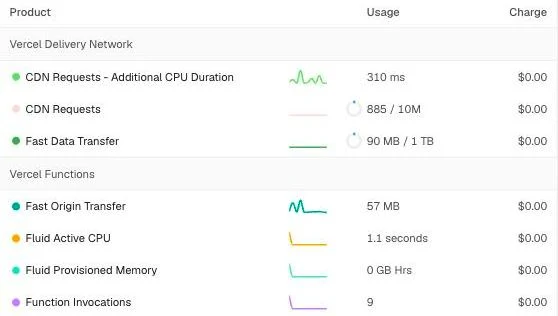
On this Pro team the usage table shows 10M CDN requests and 1 TB of Fast Data Transfer included each billing cycle.
- Select the team in the team switcher, then open Usage in the dashboard sidebar.
- Change the billing cycle dropdown to Last 30 days to see a full pattern.
- Read the allotment indicator in the overview. It shows how much of each allowance you have used and the projected cost of each item.
- Review the breakdown by project and region, and use the Ratio view to compare cached and uncached requests.
From the terminal, vercel billing usage --since 30d --group-by project gives the same 30-day view, and --group-by region splits it by region. High Fast Data Transfer usually means large images, video or downloads. High outgoing Fast Origin Transfer, or a low cached ratio, means function responses are not being cached.
Then set a ceiling. New Pro teams get a default spend amount of $200, which sends notifications but does not pause projects. You can change the amount and choose to pause projects or call a webhook when it is reached.
How can you cut a Vercel bill without moving?
Most high Vercel bills come from uncached traffic and oversized media, not the platform fee. Work through these in order.
- Cache function responses. Add caching headers such as
Cache-Controlwith s-maxage and stale-while-revalidate, orVercel-CDN-Cache-Control, so repeat requests are served from the CDN. This cuts Fast Origin Transfer, invocations and CPU. - Return ETag or Last-Modified headers. The CDN can then answer repeat requests with 304 Not Modified instead of the full body.
- Limit middleware with a matcher. Vercel warns that middleware can incur Fast Origin Transfer twice on one request.
- Tune image optimisation. Raise
images.minimumCacheTTLfrom the four-hour default for images that rarely change, trimdeviceSizes, set thesizesprop and measure before adding AVIF, which doubles cache variants. - Move large static files off the CDN meter. Bulk downloads and large media are out of scope for Flat Rate CDN; serve them from storage priced for that job.
- Cut needless requests. Polling and refetching data on window focus multiply CDN requests and invocations.
- Price Flat Rate CDN. If transfer dominates, a $20, $100 or $300 tier may beat on-demand rates.
The image steps come from Vercel's guide to reducing Image Optimization costs, which also suggests the unoptimized prop for logos and icons.
When is moving to Cloudflare Workers worth it?
Moving is worth it when bandwidth or seats, not features, drive your bill, and your framework runs well on Workers. It is rarely worth it when the bill sits inside Vercel's $20 credit, because a migration costs developer time that a few dollars a month will not repay.
| Feature | Cloudflare Workers | Vercel |
|---|---|---|
| No bandwidth charge on the paid plan | Yes, no charge for data transfer | Partial: 1 TB on Pro, then from $0.15 per GB |
| Free static asset requests | Yes, free and unlimited | No, counted as CDN requests |
| No per-seat fee | Yes, $5 minimum per account | Partial: $20 per deploying seat, viewer seats free |
| Preview URLs for branches | Yes, through Workers Builds | Yes, for branches and every pull request |
| Zero-configuration Next.js | Partial: vinext, in beta, or OpenNext | Yes, Vercel maintains Next.js |
| Next.js incremental static regeneration | Partial: supported in vinext, which is in beta | Yes, with pages persisted to durable storage |
| Next.js image optimisation | Partial: at request time in vinext | Yes, through next/image |
Sources: Cloudflare, Workers pricing; Cloudflare, Workers Builds; Cloudflare, Next.js on Workers; Vercel, Pricing; Vercel, Pro plan; Vercel, Next.js on Vercel, all checked 21 November 2026
Stay on Vercel if your app leans on Next.js features. Vercel says it maintains Next.js and that deploying it is zero-configuration, with ISR, image optimisation, Partial Prerendering and Draft Mode handled by the platform. Its preview environments create a deployment for every pull request, protected by Vercel Authentication by default on new projects, and viewers can comment on previews. Cloudflare recommends vinext for Next.js on Workers, but vinext is in beta and image optimisation is only partly supported. The Next.js deployment docs list Vercel as a verified adapter, while Cloudflare's integration is not yet verified by the Next.js team.
Move to Workers if you serve more than 1 TB a month and growing, several people need to deploy, or your app uses a framework with a Cloudflare guide, such as TanStack Start. Run the numbers from your own Usage page first. If Fast Data Transfer is most of the bill, the saving is real. If compute is, fix caching first.
For what it is worth, circlemount.com is a TanStack Start app deployed as a Cloudflare Worker. Workers Builds deploys it from GitHub, and it reads content from Supabase. That is one content site, not proof that Workers suits every app; the setup is in running Cloudflare Workers with Supabase. We have also moved client apps off Lovable (see moving an app off Lovable) and solved egress cost problems on Railway.
If your app was built with an AI tool, our fix a vibe-coded app service reviews hosting and data costs alongside security, and app MVP development picks the host with you before launch. To budget a migration, see how much it costs to fix a vibe-coded app.
Frequently asked questions
Is Cloudflare Workers cheaper than Vercel?
Usually, yes, and the gap grows with traffic. Workers Paid starts at 5 US dollars a month per account with free bandwidth and free static asset requests. Vercel Pro starts at 20 dollars per deploying seat and charges from 0.15 dollars per GB after 1 TB. Below 1 TB a month the difference is small.
Can I use the Vercel Hobby plan for a business website?
No. Section 4 of Vercel's Terms of Service limits the Hobby plan to personal or non-commercial use, and the terms do not define commercial use. A company site, client project or app that takes payments should be on Pro, which costs 20 US dollars a month per deploying seat before VAT.
How many requests are included in Vercel Pro?
Vercel's documents disagree. In November 2026 the pricing page said 10 million CDN requests a month were included. The Pro plan and Flat Rate CDN pages said Pro includes a tier with 1 million CDN requests and 1 TB of data transfer. Budget with the lower figure and check your Usage page and invoice.
Does Cloudflare charge for bandwidth on Workers?
No. Cloudflare's Workers pricing page says there are no additional charges for data transfer, egress or bandwidth, and that requests to static assets are free and unlimited. You pay for requests and CPU time beyond the included amounts. Containers are the exception and have their own egress rates.
Why is my Vercel bill so high?
Most high Vercel bills come from Fast Data Transfer over the 1 TB included on Pro, uncached function responses that add Fast Origin Transfer and invocations, or image optimisation creating many variants. Open the Usage page, set the period to the last 30 days and check which project and region drive each meter.
Can I run a Next.js app on Cloudflare Workers?
Yes. Cloudflare recommends vinext as the default way to run Next.js on Workers, and the OpenNext adapter remains for existing apps that cannot migrate yet. vinext is in beta, and image optimisation is only partly supported, so run its compatibility check before moving a production Next.js app.
Sources
Checked on 21 November 2026. Product features and figures change quickly, so check the current source before you rely on a detail.
- Cloudflare: Workers pricing
- Cloudflare: Workers limits
- Cloudflare: Workers Builds
- Cloudflare: Next.js on Workers
- Vercel: Pricing
- Vercel documentation: Pro plan
- Vercel documentation: Flat Rate CDN
- Vercel documentation: London (lhr1) pricing
- Vercel documentation: Next.js on Vercel
- Vercel: Terms of Service
Hosting bill growing faster than your app?
We review hosting, caching and data costs on apps built with AI tools, fix what is driving the bill, and move apps between Vercel and Cloudflare Workers when the numbers justify it. See our fix a vibe-coded app service, or app MVP development for a new build. The initial app assessment is free, project work starts from £1,000 + VAT, and ongoing support plans start from £125 a month + VAT. Join the Circle to get started.